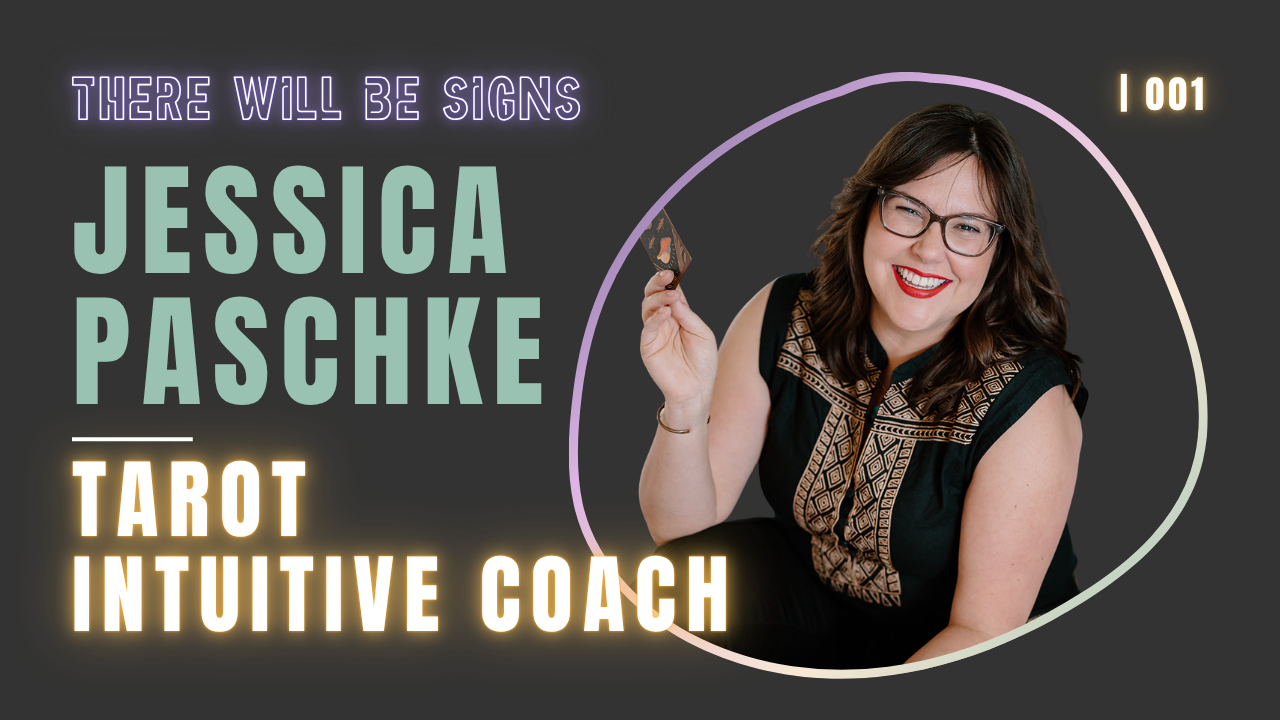
Ep. 001 | Jessica Paschke | Tarot as a Looking Glass
Watch on YouTube and hit subscribe — that's where we're building our home base.
Prefer another platform? Find us on: Spotify | Apple Podcasts | Amazon Music and more!
What happens when you walk into a psychic development circle "just to watch" and the woman leading it turns out to see you?
That's exactly how Jessica Paschke's journey began.
A spur-of-the-moment visit to a metaphysical center altered the direction of her life, leading to a deep immersion in tarot, mediumship, and psychic development.
In this episode, Jessica breaks down her "through the looking glass" approach to tarot, why she stopped asking her cards questions, and how she followed her nose (literally) up the Massachusetts coastline to find her home.
Meet Jessica Paschke:
Jessica Paschke is an intuitive coach and tarot practitioner with over 15 years of experience, working at the intersection of human-centered spirituality and real-life change. In this conversation, she shares her origin story, her signature "through the looking glass" tarot method, and how she uses energetic filters and a personal values list to discern helpful guidance from noise.
In this episode:
(~06:44) Jessica's birth chart twist — Libra Sun, Leo Rising, Gemini Moon, with nearly all her planets stacked in one Scorpio house
(~08:40) How a "get out of the house" push from her husband led her straight into a psychic development circle in Cape Cod
(~09:53) The moment the circle's leader told her she was already psychic and a medium (and didn't know it)
(~10:10) The mentorship trade that followed: writing newsletters in exchange for training in tarot, Reiki, and psychic readings
(~10:40) The eerie childhood knowing she'd had for years: always sensing when someone was near death
(~14:46) Why predictive tarot stopped working once her life (and her clients' lives) got too unpredictable to keep up with
(~15:33) The Alaska rainstorm that drenched every tarot deck she owned and why she took it as a sign to step away for a year
(~17:33) How that break led her to blend tarot with coaching, using cards as tools for self-perception rather than prediction
(~22:20) Her "through the looking glass" method, explained: using cards to step outside your own beliefs and see the frame around them
(~28:37) Why she stopped asking her cards questions and talks to them like a best friend instead
(~30:51) Energetic filters, not walls: how she protects her energy without shutting the world out
(~33:03) The five values she checks every piece of guidance against and why misaligned advice is a hard no, guides included
(~48:58) The saltwater sign: how she and a fellow medium sniffed their way up the Massachusetts coast to find her home
(~1:01:26) Her one tip for anyone building an intuitive practice: practice before you need it
Tarot Centric Book Recommendation:
78 Degrees of Wisdom by Rachel Pollack (revised edition) — Jessica loved it so much the binding cracked and the pages fell out.
Find it and more on our book recommendations page.
Free Tarot Course:
Jessica offers a free beginner's tarot course — a great starting point if you're tarot-curious and want to build the practice she talks about in this episode.
Connect with Jessica Paschke:
Website: jessicapaschke.com
Instagram: @intuitivebythesea
Facebook: Jessica Paschke
Newsletter: Sign up here
-
There Will Be Signs (00:00) What if the universe is in a constant state of sending you feedback? Welcome to There Will Be Signs, a podcast that celebrates the stories, synchronicities, and strange nudges that remind us there's more to life than what we see. Here we'll talk to deeply intuitive guests and offer practical ways to connect to the magic, whimsy, and unseen helpers that exist around you every single day — because you are supported, dear listener. It may not always feel that way. There will be signs.
Killian (00:34) Hi Amanda, how are you doing?
Amanda (00:36) Hi, Killian, I'm great. How are you?
Killian (00:39) Wonderful. Thank you for joining me on this adventure. This is our first episode. How are we feeling?
Amanda (00:44) Feeling good, feeling psyched.
Killian (00:46) Super psyched.
Amanda (00:47) Excited!
Killian (00:48) I want to take a moment before we start to just address anyone who's listening — thank you for being here. What's really funny is that when I was thinking about this whole podcast idea, the core belief that you and I have is that there are helper energies in the universe.
Amanda (01:06) Mm-hmm.
Killian (01:07) And there are so many different ways to tap into those helper energies. One of the bridges is through signs and synchronicities, and really learning how to discern what signs are meant for us to follow and what signs might be meant for us to avoid.
I was thinking about that in the context of how I look for podcasts — what makes me choose to take a chance on a new podcast I've never heard before. In marketing there's this term "early adopter." There are people out there who are just willing to jump in — "hey, this looks cool, I'm going to try it." I'm not that person. Any trend that comes around, I'll watch other people do it first, and when it feels safe, I'll jump in.
So if you're listening to this at our very first episode — thank you for being a risk-taker. Thank you for not being like me. Who are you?
Amanda (01:57) Yeah, where did you come from? Tell us — how'd you find us?
Killian (02:01) We'd love to learn a little more about you, but thank you for being here more than anything.
Amanda (02:07) Do you have a talent? Do you have guides? Tell us.
Killian (02:11) Do you want to be a guest on the show? No — we're just really excited to be here. This is a concept that Amanda and I love talking about. We've known each other for 20 years, since college, which dates us. Maybe I shouldn't have said that, but here we are.
Amanda (02:24) You know what, we're fabulous. All the millennials, we're rocking it. Every day we're learning more, we're getting better — in my opinion. I believe that. I really do.
Killian (02:33) Sure, yeah, we'll go with that. No, I believe it too.
But today we have a very cool guest. I'm going to read her bio. Our guest today is Jessica Paschke. She's an intuitive coach, a tarot practitioner, with over 15 years of intuitive practice. Her work sits — this is how she describes it — at the intersection of human-centered spirituality and real-life change.
She approaches the cards not as a mirror for reflection, but as a looking glass — a doorway into the parts of ourselves that don't show up in ordinary self-examination. Her practice helps women move from spiritual insight into intentional action, from who they've been into who they're choosing to become.
She's an incredible first guest, because the whole concept of signs is about inner discernment — about action. We're making decisions every single day.
Amanda (03:38) Every single minute. Literally — I missed a call because I was deciding to do the dishes and didn't hear the phone. Something could've changed because I didn't answer. Something could've changed because I called back at a different time. Every little thing is a butterfly effect.
Killian (03:56) That really is the human experience — a series of choices. People talk a lot about how there's no such thing as time, but I think we came down to this planet and experience reality in a linear way because of how it restricts us — because we're constantly forced to make decision after decision, knowing those decisions are going to have impact and consequence.
As a little kid, that used to drive me nuts — especially big life decisions, like choosing where to go to college. I remember thinking, this is the first decision I get to make. Everything else had been decided for me — moving because my dad got a job, whatever it was. This was mine, and it was going to impact the rest of my life. And it did — I married a guy I met at college.
Amanda (04:45) Yeah. I met him too. He was a great choice.
Killian (04:51) He is a good time.
Amanda (04:53) I was going to say "he was a good time," but that sounds terrible.
Killian (05:01) It's true, though. It can consume us if we think about it too hard — how these decisions have impact.
Amanda (05:11) Most of it just flows — it's your day. But even though it's not all-encompassing, it does impact.
Killian (05:19) Yes. And for anyone who gets caught up in this and starts to spiral — something that's helped me a lot is remembering there's always a new doorway, a new path. If it feels like a choice is locked in and that's scary, there's always an off-ramp. You can always make another choice. It becomes gamified, almost.
Amanda (05:45) Oh my god — maybe that's why I love Choose Your Own Adventure books so much.
Killian (05:51) Yes! I used to love those too, and here we are.
Amanda (05:57) Why don't we have those more as adults?
Killian (06:01) If you think about it, Amanda, this entire podcast is an exploration of choosing your own adventure.
Amanda (06:06) Maybe life is just that.
Killian (06:07) So today's adventure is meeting with Jessica, and I'm very excited for how this is going to flow.
Amanda (06:13) Me too!
Killian (06:15) Jessica, we are so excited to have you on the show. Thank you for being here. This show is really about exploring signs and synchronicities — about tapping into our own internal dialogue when it comes to discernment and feeling confident about our intuitive pull. I know tarot is such a huge part of that. I'd love to dive in by asking — your sun, moon, and rising?
Jessica Paschke (06:44) I'm a Libra Sun, Leo Rising, Gemini Moon. But here's the twist — almost all of my planets are in one house, in Scorpio. So I actually show up as more Scorpio than anything else.
Killian (06:57) No way.
Amanda (07:01) Wow.
Killian (07:03) How's that been for you?
Jessica Paschke (07:05) Being a faux Scorpio — intense. I love to dive deep. That comes through in my work, my relationships, my conversations. Everything is "how deep can we go?" I love that intimacy of connection rather than something broad. But then I also have a real passion for justice, which comes with Libra, and clearly I don't have a problem with visibility, which is the Leo. It's fascinating how it shows up.
Killian (07:40) Random question — do you have siblings?
Jessica Paschke (07:42) One sibling.
Killian (07:44) My brother's a Scorpio too. As a child, were you sneaky about how you teased your sibling?
Jessica Paschke (07:50) 100%. Great question. I'm sure she'd affirm that too.
Killian (07:57) That was my brother — so sneaky about tormenting me, and I'd always get blamed for it.
Jessica Paschke (08:09) Yes — really sly and quiet. There'd be moments where I'd set her up, knowing she'd explode, and I'd just nudge it a little in that direction.
Amanda (08:25) You sneaky witches!
Killian (08:29) That actually makes sense with what you found. I wanted to dive into how you found tarot — tell us your backstory. How did you land where you are?
Jessica Paschke (08:40) It's a big one, but I'll keep it succinct. I was a military spouse for 22 years — my husband was in the Coast Guard. We moved everywhere, about every three years, somewhere I didn't know anyone.
We'd just moved to Cape Cod, Massachusetts, and I'd had a baby — she was maybe two weeks old when we moved. About five or six months in, I still didn't really know anyone. My husband said, "You need to get out of the house — I've got the baby, go." There was a psychic development circle happening.
Killian (09:26) Boo!
Jessica Paschke (09:27) Yeah — and I'd never been to one. I was very intuitive, very empathic, but I didn't think I was a psychic or a medium. I figured I'd go and just watch other people be psychic. Fun, right?
I showed up, sat in the circle, and when it wrapped, the woman leading it said, "Did you know that you're psychic and a medium?"
Amanda (09:53) Did you know you're in a coven now?
Jessica Paschke (09:56) Exactly. She ended up hiring me to do her social media and newsletters — this was eons ago — and said, "In exchange, I'll teach you tarot, certify you in Reiki, and teach you psychic readings. You just have to write my newsletter and social posts."
So I ended up working there and learning very quickly, because it turned out I'd apparently been psychic and a medium all along — I just didn't know that's not how everyone operates.
Amanda (10:29) Nothing came up looking back that you thought, "wait, yeah, I knew that"?
Jessica Paschke (10:40) This is going to sound ridiculous, but growing up, I always knew when someone was going to die. If they were in the window where it was too late to do anything about it, I would know. That was through my twenties and beyond. I always got to say goodbye — I never told them, that wasn't my responsibility, but there was a sense I knew. I didn't realize at the time what that was.
Amanda (11:07) I'm like that with everybody every day — I don't know what's going to happen, so I better love you hard.
Jessica Paschke (11:13) That moves you into that state of love. Looking back, there were signs.
Amanda / Killian (11:22) There were signs.
Killian (11:22) It sounds like a classic hero story — you show up somewhere, a mentor appears and says "you are the chosen one, I will usher you into your place of being." Which is funny, because that's always something I've wanted — to run into a magical crone who picks me and says, "here's the path you're supposed to be on." But at the end of the day, you are your own savior, your own guide, your own hero. Being able to see the signs and interpret them is the important piece in figuring out what path you belong on. But I love that you had this mentor figure — that's powerful too.
Jessica Paschke (12:15) It was at a metaphysical center, so there were always people coming through. She'd teach me a bit, then I'd ask someone else. It was probably a decade's worth of education compressed into a couple of years, because I was immersed and staying curious, figuring it out. A lot of it was "what are my guides working on right now?" — they were really instrumental in the mediumship.
Killian (12:45) Talk about the importance of community too.
Jessica Paschke (12:46) Yes! Having people who are just as interested in this metaphysical stuff as you are — that's huge.
Amanda (12:53) I'm still waiting for my guide. As a Pisces I could really use some direction.
Jessica Paschke (13:04) Everyone feels that way. People come to me because they're in uncertainty. You're not reaching for a reader, getting your chart done, or your human design done because everything is great — people usually show up because there's something uncertain in their lives. They're in transition, they don't know what's going on, and they're reaching for clarity.
At the same time — and this is where it gets to what you were saying — you have to have discernment for yourself. There is no reader, no mentor, no guide who should be telling you what to do. They should be saying, "here's what I'm seeing, here's the energy I'm picking up on." But at the end of the day, it's you that makes the decision — no one else.
Amanda (13:51) It's therapeutic — like therapy. Everyone wants to go and be told what to do, and that's not what they're teaching you. They're giving you tools to get onto your path, figure out the next step, ask the right questions. It's the old proverb of teaching someone to fish — figuring out the tools within ourselves.
Killian (14:20) Amanda and I have both gone to intuitive guides and healers of all kinds. It's funny when something someone says doesn't resonate — that's also your inner guide telling you, "no, that's not the path." You have it all.
So — in terms of what you do now, do you spend most of your time working with tarot? What's your process?
Jessica Paschke (14:46) Tarot has really evolved for me. When I learned it, it was one of the very first tools I picked up — I was taught predictive/intuitive tarot, combining intuition with the cards. I did that for years, but it wasn't working with my lifestyle, because we were moving every couple of years, constantly in a cycle of uncertainty — you don't get to choose where you move. No matter how many cards I drew, it wasn't giving me enough to make that okay. And with my clients, they'd come in with uncertainty, I'd pull cards, we'd get clear — but a year later they'd come back, still uncertain. It wasn't changing anything fundamentally.
We'd just moved to Alaska — I'd been there 24 hours, unpacking boxes of cards, setting them up on the windowsill before running to get my daughter from preschool. I thought, "they'll be safe." I came home, it was raining, and the window seal had been broken — we didn't know because we'd just moved in — and it drenched every single deck I owned.
I was already frustrated with tarot in general, and this felt like the nail in the coffin. I dried everything, flattened every card under books, boxed them, put them on a shelf, and didn't touch them for a year. I thought, "this is a sign — all my decks are washed out, step away."
Killian (16:45) Talk about a sign.
Jessica Paschke (16:47) When I came back to them a year later, something had changed. I realized we had to work with this differently for it to actually work — for me and for my clients. So now I've blended tarot with coaching, using the cards as visual coaching tools that help people access their inner landscape and experience themselves differently. It opens up a whole world of information that intuitive or predictive tarot alone didn't.
Killian (17:33) I've never heard tarot broken into categories like that — predictive, intuitive. Are those the main ones people use?
Jessica Paschke (17:41) That's the brilliant thing about tarot — you can layer almost any framework on top of it. Intuitive tarot is tuning into your intuitive (maybe psychic) skills and flipping cards to see what messages come through — maybe from spirit guides, depending on your intention.
Divination or predictive tarot is more "tell me the future" — often with a timing element, like how many months before you meet someone or find a job. People who do that well, with real training, can blow your mind — but it takes years to be accurate.
Amanda (18:59) I can't fathom getting concrete numbers or timing off it.
Jessica Paschke (18:59) I was trained in it, so I know how it works — it just wasn't working with how my life was unfolding. My real life didn't match that style of tarot, and the clients I was attracting needed something different, because we could flip cards, and two days later the energy would shift — a different decision gets made, something out of your control happens, and the whole reading's outdated.
Amanda (19:28) Butterfly effect, every day, every corner you turn.
Killian (19:33) The future's always changing, so it's genuinely hard to predict — especially now, when everything moves so fast.
Jessica Paschke (19:49) We're getting information faster, our perspectives shift faster. The world is infinitely more connected — it used to take days for information to travel; now someone posts on the other side of the world and we get it in seconds. It's a wild time to be alive.
Amanda (20:19) I read once that we're not meant to have all the information from around the world at all times — it's a lot to process. Wanting to make the world better and speak up together is amazing, but taking in that much every single day, especially for empaths, hits hard. Hundreds of years ago you'd never have known, never been affected. I'm not saying it's all good or bad — just very impactful.
Jessica Paschke (21:15) It creates a lot more uncertainty, because you never know what's coming and there's no break to sit, digest, process. We're constantly in flux — it's a lot for the body and brain to handle.
Amanda (21:32) Stories don't always wrap up — the news moves to the next thing and you never really know what happened.
Killian (21:45) It's very disorienting to live this way. Jessica, as you were talking about there being no time to process, I felt myself take this deep breath — like my body just wanted to process. I just needed a second.
Amanda (21:59) It's like finishing a book and going "okay, done" — except there's a hundred more chapters every day.
Jessica Paschke (22:10) Always a hundred more chapters.
Amanda (22:12) That's life. There is no done.
Killian (22:20) Tell me about how this visual tarot approach actually works for your clients — an example of how you're engaging with it?
Jessica Paschke (22:33) I teach this in my Through the Looking Glass class. It's a combination — we're using the cards to access our inner landscape so we can see ourselves differently, which allows us to take action.
I explain it through Alice — she's sitting in her parlor, looks at the mirror, and realizes it's not reflecting back what she expects. She gets closer, pushes her hand through, falls into Wonderland, where things are the same but backwards, upside down — different enough that it changes who she is. When she steps back through the mirror, she's a different person.
That's what we're doing with tarot — not using it just for reflection. When we stand in a mirror, we basically know what we'll see. But if we step through the mirror, we're outside the frame — and the frame is where all our beliefs, thoughts, stories, and patterns live. We sometimes respond to that frame without realizing it isn't updated for who we are today.
So we hold up a card and step through: what's going on underneath? What's the frame? What's happening? How does that change how I want to respond? Then we pull back through. It involves intuition and reading energy, pulling in messages from your team — but combined with a very human-centered piece: what's happening to our human self, and do we want to carry that forward? How do we want to shift?
When they come back through the looking glass, we talk about intentional action — what do we want to do next, what do we need to build so we don't experience this again. That was my big realization: you want to help people, but if they come back in six months in the same place, something's missing. They need more. So now we use tarot as the "more" — helping them look at the actions, skills, and practices they need to actually create the change they're looking for.
Killian (26:01) When they come out through the looking glass, is it about embodying the cards, or using them as tools for action steps?
Jessica Paschke (26:01) Sometimes it's an energy to embody, but often it's more hands-on — "I didn't realize this belief was interfering," or "this was triggering me to react from this place — now what needs to be in place instead?" That's where the coaching side comes in: what do we do with that story, that belief? What action would you take instead? What are your values? All of that comes into play, even though it's more than an hour of work.
Amanda (26:53) It reminds me of a good, holistic doctor versus one who just hands you medicine and sends you off — looking at sleep, diet, work-life, the whole picture. This card tells you one thing, but once you factor in everything else, it's a much more accurate picture.
Jessica Paschke (27:46) Both approaches help — there's a time and place for both. But if you really want to change something, you have to approach it from all the different facets.
Killian (27:57) I use tarot almost daily myself — I'm self-taught, so it's fun hearing how you've built this out. I think tarot can be a beautiful guide, almost like parts work in therapy — helping you see the various parts of yourself and what needs healing. It's also about asking the right questions, I'm sure.
Jessica Paschke (28:37) That's why we shift into having a conversation instead of asking questions. When I teach beginners, I don't have them ask questions — the question will screw you over every time. They're hard, they take practice, you have to word them right. Even after a decade of experience, I'm still sorting through what the actual question is.
I always tell people: shuffle your cards and talk to them like they're your best friend. It lets the cards take you where you need to go, rather than you forcing a card into a question. How many times do we talk to a friend who doesn't give a single piece of advice, but we work through it just by talking?
Amanda (29:37) Every time you talk to a woman, honestly. I'm working through it in my own head more than expecting advice — though of course I want that too sometimes. More often we're talking it through instead of "here's your answer, open the gift."
Killian (29:57) This is a great segue into the theme of the show — we hold this core belief that there are helper energies here to support us, and the world right now is a lot. I think we all need to feel like there are energies we can latch onto to help navigate our lives, individually and in community. When I think about helper energies, I naturally also think about less helpful ones. As a kid I was really sensitive to intense, unhelpful energy. In your practice, how do you make sure the guidance coming through the cards is coming from a helpful place, not a mischievous or unsupportive one?
Jessica Paschke (30:51) On a simplified level — energetic filters. I don't think of them as walls or shields, more filters, and you set the parameters for what's allowed through. I live in New England — everywhere you go, there's something — but it's filtered out for the most part. I don't want to be wide open, so we turn the volume down on some things and up on others.
I think that's a good first step for people. As for knowing if something's helpful — it comes down to knowing yourself better. When you know your inner voice, and take the time to get to know your guides, your team, your ancestors, you can filter based on what resonates with your "clairs" and what doesn't. I fire on all cylinders with mine — I was a psychic medium for so long, I'm seeing, hearing, smelling, tasting, knowing things, and I know what's what by now. I also ask my guides and ancestors to filter out what I don't need. But mostly it's knowing who I am and what my inner voice sounds like.
Killian (32:34) This is helpful for anyone newer to tarot or divination who hasn't learned to discern "that energy doesn't feel like mine" yet — what's a good starting point?
Jessica Paschke (32:57) This is going to sound random, but hear me out: figure out what your values are.
[Ad break — There Will Be Signs (33:03): a quick ask to subscribe, leave a five-star rating on Apple Podcasts, comment on YouTube, and share the show with a friend.]
Jessica Paschke (33:55) Three to five values that are important to you. If advice doesn't line up with your values, it's not for you — and it should line up with all of them, not just one. I have five values, and if a decision or piece of guidance doesn't line up — even from my guides — they'll have to take it back to the drawing board. These are the things that matter to me in this human experience, and it has to align. I tell my students: put your values on a Post-it or index card, check everything against it. If it doesn't line up, it's a hard no, no matter what it is.
Amanda (34:45) Can we ask what your values are?
Jessica Paschke (34:49) Curiosity — you have to be curious. Joy — I've been through a lot in this lifetime, so I'm always looking for moments of joy wherever I'm at. Grace — for myself and others; I don't know how you navigate the world today without it. Connection — with other people, self, soul, and spirit. And congruence — taking everything that matters and actually applying it, integrating it, showing up and using it intentionally. Those are my five, and they show up in every teaching space and decision I make. When they're not present, the agitation is fast and clear.
Killian (35:48) The signs are there.
Amanda (35:48) Can I go back one step? When I've gone to readings, sometimes people say "don't worry, only good things are coming through" — do you think readers are purposely filtering out anything negative because people find it taboo or scary?
Jessica Paschke (36:27) I think it depends on the kind of reader you are — if that's your thing and what you're known for, more power to you. For me, that hasn't been how I've experienced life — we're going to have difficulties and challenges, and personally I'd rather know where those might surface, so I can meet them with intentionality — not predictively, but so I can prep for a hard conversation, imagine how it might go, what I want to remember.
I think seeing both sides is important. But if you're going to bring something hard into a reading, you'd better be able to hold that space and resolve it so the person isn't walking out spinning. I've seen readings that are all dark and that poor person is just spinning. You have to know your container and the agreement between you and the person in front of you.
I'm never going to tell someone something untrue just because it's uncomfortable, but I'll frame it as themes — "these are the themes around this card." It can show up as barely noticeable or as a 10. We don't know which it'll be — that depends on a lot — but this is the theme, this is the energy, and to be aware of it.
Killian (38:28) Energetic protection feels like such an important part of that conversation. Your answer about discernment is great because it encourages people to actually make that values list — so many people don't have one and don't know their own values.
To dive more into cards — how often do you use them for yourself? What's your personal practice?
Jessica Paschke (39:12) Depends on my season of life. A lot of times I pull a card a day and really sit with it, go down the rabbit hole — what wants to be written out, what wants to be explored. Busy days, I might pull a card, set an intention to come back to it later. And sometimes I don't pull cards for a while, because I don't need to — I can access guidance in other ways. The other day I was sitting on the deck near the ocean, early morning, birds singing, and my guides just dropped in — a direct conversation, thoughts and impressions coming through — I didn't need a card that day. But when you're first learning, drawing a card daily is really helpful.
Killian (40:33) Looking at tarot as signs is interesting — most people think of signs and synchronicities as random occurrences, like bumping into someone on the street. Tarot is much more intentional — you're choosing your own sign, in a way.
Jessica Paschke (40:47) It's like 78 signs in a deck. Choose your own sign.
Killian (40:59) I want to share a story — sometimes cards fall out of the deck, which is like a sign within a sign. Over the last two years, I keep pulling the same card no matter how much I shuffle — the Emperor. I have two small kids, my youngest is a year and a half, and it started around two years ago. The message, for me, is about claiming my own inner authority back — getting back on my own throne, going after what I want, delegating. Every time I pull the Emperor, it feels like my guides saying, "again — keep trying, keep this in the forefront, you're almost there." Have you had a similar experience with a recurring card?
Jessica Paschke (42:12) Haven't had a stalker card in a while, actually — surprising, since they do tend to show up. Mine tend to be more reassuring, like "we've got you, keep going." Even in the hardest times, I wasn't stalked by the Tower — the Star shows up quite a bit, often at odds with what I'm experiencing, and it's a reminder that even in the darkest moments there's hope and light. That one shows up when I'm going through things.
Amanda (43:10) That's my card too — the Star. Also, you need to get an Emperor tattoo, Killian.
Killian (43:21) That would be fun. The Emperor is actually an Aries card, and I'm an Aries — and can we take a moment for the fact that there are seven planets in Aries right now?
Jessica Paschke (43:30) This week is bananas — every time I open my astrology app, I'm like, "okay, what's happening today?"
Amanda (43:41) I told Killian before this — let me tell you about my week, it is chaos.
Killian (43:57) And I'm an Aries sun and rising, so I'm just like, bring it on — isn't this good? Why doesn't anyone think this is good?
Amanda (44:07) I'm like, it's a little hot in here. I came in with sleepy energy — how dare I take on another project right now.
Killian (44:25) It's so interesting seeing how everyone interacts with different energies. I'm curious — favorite card, and which card do you think is the most misunderstood?
Jessica Paschke (44:38) Favorite is hard — I love all my children equally. Each one has a job, and together they create the most exquisite, detailed picture of the human and soul experience. But I'll admit the Lovers can be a little annoying — "yeah, that's why I'm here, making a choice, thanks for identifying the obvious." And the Ten of Swords gets me too, because it shows up when I'm already burnt out and cooked, telling me what I already know.
Most misunderstood — the cards that look darker in traditional Rider-Waite imagery: the Devil, the Tower, Death. When I flip Death for someone who's never had a reading, I immediately say, "don't panic, it's not what it looks like — take a deep breath, this isn't some '90s teen movie." I think the cards that show us what we're most afraid to look at, or remind us life isn't forever, get labeled "bad" when really they're just part of us.
Killian (46:39) I have a hard time with the Three of Swords — the three swords through the heart, because of the grief. It always hits me hard, and I want to throw it, even though it's actually a healing card if you interpret it that way.
Jessica Paschke (46:56) If we're grieving something, we've loved something — that's why the heart is in the picture; both are true at the same time. You can have joy and grief simultaneously — they don't cancel each other out. I think that card represents both the heart and the swords.
Killian (47:35) Before we wrap, do you have any other sign or synchronicity stories? The rain story with your decks was wild.
Jessica Paschke (47:52) I have so many. Remember, I'm a medium too. In 2022 — my "year of life quakes" — after a year of cancer, my dad passed away in May, a month later my husband was diagnosed with brain cancer, and a month after that my grandmother died. Bam, bam, bam.
We had to go to Boston for his healthcare — we were living in the Outer Banks at the time, so we left my daughter with my mom and moved up there for four months. My closest friend, an incredible psychic medium in Connecticut, said, "I'm coming to get you out of that apartment — we're going to look at towns, see where you might want to move," since we knew it was long-term, not a cure situation.
So we drove around all summer, and I said to my guides, "I need a sign — if this is where we're supposed to live, I need signs." I told her, "the sign is: if we can smell saltwater, it's an option; if we can't, it's not." She's been doing mediumship for 30 years and told me that was the most ridiculous thing she'd ever heard. I said, let's just try it.
We drove up the North Shore of Massachusetts to Ipswich — off the ocean a bit, but there — and I smelled salt. Ipswich stayed on the list. Gloucester too, obviously. Then Manchester-by-the-Sea — we got out at the dock, ocean lapping right there, and — no salt smell at all. She couldn't believe it; she'd never seen anyone work with spirit guides quite the way I do. We tested it up and down the North and South Shore — standing right on the ocean, sometimes no saltwater smell at all.
Killian (51:03) Did that come through your guides, or did you choose it?
Jessica Paschke (51:04) My guides — they dropped it in.
Killian (51:11) Do you think you can choose your own sign and have your guides follow through — like saying "show me a butterfly"?
Jessica Paschke (51:15) 100%. A couple weeks ago I kept getting bird signs — I love animal-speak, love pulling up what something means. I had my office window cracked an inch, burning incense, and a little bird flew in and flew all around — so of course I looked it up. After that, it was bird sign after bird sign — dive-bombed by a swan, an eagle or hawk flying within inches of the window — for weeks. My only ask was "please don't let them die hitting the window, I promise I'll look them up." Every one matched what I'd been thinking through.
Killian (52:29) Amanda and I talk about this constantly — living a life where you embrace enough whimsy that everything can become a sign. For me, if something dramatic happens with an animal, I go straight to my book and look it up. Maybe it's confirmation bias, but it does seem to align — when you look into what an animal represents, it's often exactly what you're going through, or a message you needed. I love talking to people who live this way too — it's such a delicious way to move through life.
Jessica Paschke (53:24) There's just so much more magic in it. Spirit and source are beyond what we can even grasp — why wouldn't they be able to communicate through these amazing animal beings, who have their own wisdom and medicine too?
Amanda (53:57) I'm a crow girl, personally — crows all over my neighborhood. One day about 20 of them walked with me block by block, flying ahead to the next one each time. It felt outrageous, like I had an entourage — I felt like a queen, like a Disney princess saying hi to butterflies and squirrels every morning. But no one's ever talked to me about it quite like you two.
Killian (54:35) The crows are so perfect for you, Amanda — that part of you that can hold the void, the moody Piscean energy. I love it.
Amanda (54:50) I like being me. Took a while to get there, but I'm here.
Killian (54:57) Jessica, how did you first meet your guides and spirit team? Did you call them in? What are they to you — how do you define who they are?
Jessica Paschke (55:12) The ultimate backup team, a support network. Once I intentionally opened up my mediumship, my guides were front and center — but I realized they'd always been there. I'm very clairaudient — the voices and tones I'd heard sporadically since I was very young matched who they turned out to be once I sat down to connect intentionally.
I treat them like a great support team — they're here, they're not going to tell me what to do, but they'll help me see things differently, listen, or bring me signs when I'm looking in the wrong direction — like someone gently turning your head and saying, "no, it's over here."
Amanda (56:15) Do you find it's a mix of familiar and unknown voices, or do you always know who it is?
Jessica Paschke (56:26) With my own team, they're all very familiar. I believe our guides come in with us at birth — an inner table — and then as we need different guides through life, an outer band steps up for a season and steps back, like seasonal friends. I joke that my core team conned me into becoming human again — "no, it's a good idea, it's a good idea."
When I'm doing readings or mediumship for someone else, I'm not using my own team to connect — my team comes in on my right, and other people's teams come in on my upper left, because their team knows them better than mine does. So I reach out to their team instead.
Killian (57:59) I love that you can differentiate that. For me, my guides seem to come from the back of my head, while my own thoughts feel like they're in the front.
Jessica Paschke (58:05) Yes — that's a good way to describe the location. It's interesting, isn't it?
Killian (58:15) Because of your mediumship gift, even in a space like this call — can you feel other people's energy, guides included?
Jessica Paschke (58:21) If I turn that volume up, yes — it would be more than just us. But it's very intentional, because I can't go around picking up everything. I set the intention to turn it down unless I've deliberately created a space to welcome something specific in.
Killian (58:56) How did you learn to do that — was that through the psychic group, or did they teach filtering tools?
Jessica Paschke (58:56) My guides did most of the work on the filtering, honestly, through a lot of exercises together. I also read the books that were out there and adapted things to fit what I needed. It's a lot of experimentation — what works for me may not work for everyone, so when I teach, I say "let's start here, then adjust it to meet you where you're at."
Killian (59:41) Where did you end up landing, by the way — with the saltwater?
Jessica Paschke (59:46) Just south of Boston, right on the ocean. If I crack my windows, I smell the salt air every day.
Killian (1:00:07) That's phenomenal. Years ago I read Gabby Bernstein's book about picking a sign and then noticing it when you're on the right track — I picked a skunk, since it had shown up in cards I'd drawn ages ago, and I liked what it represented. I figured I'd never actually see one. It's amazing how much skunk-related stuff I see now — it's bananas. And it's changed my brain — now when I smell a skunk, I get excited.
Jessica Paschke (1:00:56) That's awesome.
Amanda (1:00:56) There's something in psychology about that.
Killian (1:00:58) Exactly — it's all about framing.
Jessica, I have to say — you've been the perfect first guest for us. Thank you for indulging us with your knowledge. I'd love to leave listeners with one tip — whether it's tarot, or accessing their own guides — for anyone who wants to exercise these skills a bit more.
Jessica Paschke (1:01:26) Lamest tip ever — it's practice. Practice before you need it. A lot of times we reach for the cards or our guides when we're already in the thick of it, and that's actually the hardest time to get a clear connection — even for trained people. You want to learn how you work before you need it, so you're not trying to do two things at once: get support and figure out how you work in the moment. Practice, practice, practice — get familiar with how you work, how your guides speak to you, how you want to work with your cards — and it becomes second nature when you need it.
Killian (1:02:07) And build your values list.
Jessica Paschke (1:02:08) And use them.
Killian (1:02:14) Where can folks find you?
Jessica Paschke (1:02:15) My website is jessicapaschke.com, and if you want to sign up for my newsletter, it's jessicapaschke.com/newsletter — I drop a lot of fun things in there: tarot, uncertain times, spirituality and practices, sometimes meditations and PDFs. You can also find me on Instagram at @intuitivebythesea, or Facebook as Jessica Paschke.
Killian (1:02:42) This has been a dream.
Jessica Paschke (1:02:44) Thank you so much for having me — so much fun.
Killian (1:02:47) We really enjoyed chatting with you and having you as an early adopter, coming on board so quickly.
Jessica Paschke (1:02:54) From the moment I read the description, I was like — wait, no, I'm reaching out to that one.
Killian (1:03:01) Y'all have a great day. Bye.
Amanda / Killian (1:03:04) Bye, Jessica. Take care.
Killian (closing note) I want to share a couple of quick extras Jessica sent us after our interview.
We've started asking all our guests to recommend a book that really moved them on their path — there's a page on our website featuring all those book recs with links to purchase, though we always suggest supporting your local library and checking them out for free first.
Since Jessica was our first guest, we hadn't gotten into the habit of asking yet — but when we followed up over email, she recommended Rachel Pollack's 78 Degrees of Wisdom (revised edition). She said she's had to buy it twice, because the binding cracked and the pages fell out after years of use — which is about as good a testimonial as a book can get.
Jessica also offers a free beginner's tarot course, linked in the show notes — perfect if you're feeling tarot-curious. There's no fee; you can find it at jessicapaschke.com/offering/tarot-simplified.
Thank you again for being one of our earliest adopters — we couldn't be more appreciative. Help us get the word out — like, subscribe, review, all the good things. Much love. See you next time.